


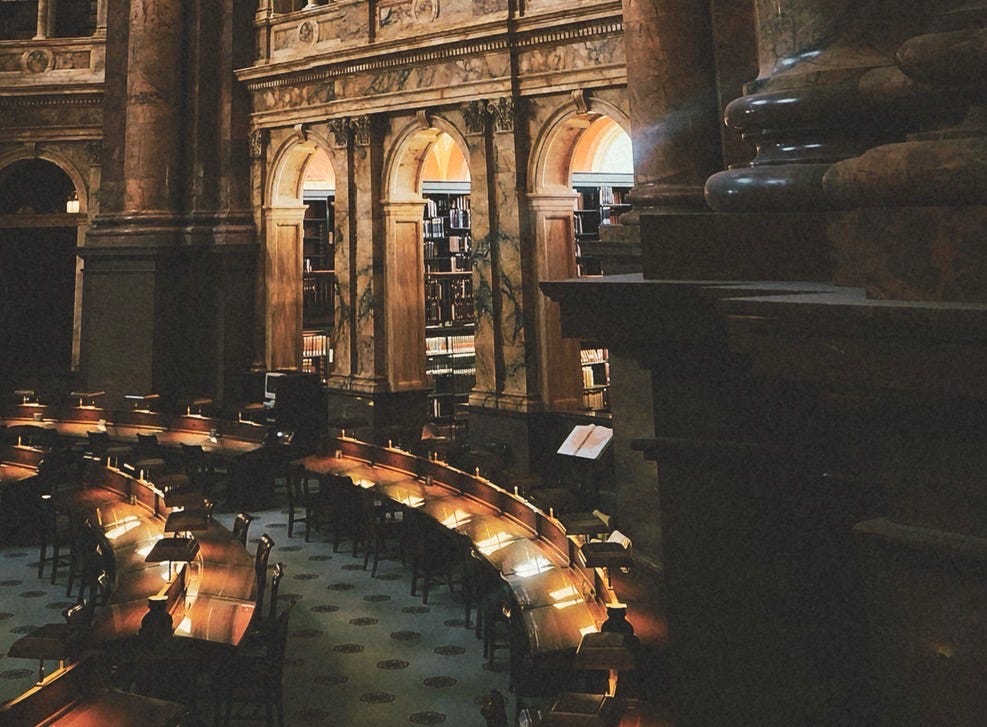
A friend said a man tried to convince her that DC is the intellectual capital of the world.
I laughed.
There’s quite a few better options. Within the U.S. alone, Boston is known for its universities and medical centers, San Francisco is famous for tech, and New York City and Chicago for finance. Washington’s main export isn’t brains, it’s narcissism.
In the past, Oxford in England or Alexandria in Egypt could have been the answer. Today, there doesn’t seem to be a single city deserving of that title.
Could the internet be the new “intellectual capital of the world?”
It allows people to freely share ideas from across the globe. You can collaborate on projects with people you’ve never met before and probably never will. It’s the largest library of knowledge in modern existence.
The internet is the place. And yet, it’s not sufficient. Look at how remote work has gone to see why. There’s certain aspects of discussion that take more than just an email. With artificial intelligence, while an efficient tool, it’s practically impossible to know what’s human, let alone what’s accurate. In-person conversation removes that barrier.
“Let us remain faithful to the truth! Living amid incessant flows of information, opinions and images, we know how easy it can be to influence decisions and preferences through increasingly sophisticated algorithms. In this context, it is imperative to cultivate hearts that love the truth, prefer what is right despite the most appealing content and pursue wisdom rather than immediate results.”
My friends gathered over drinks recently to discuss the latest encyclical, some of us not even Catholic but recognizing the value behind the statement. We all use AI at work, and it’s been a great help for us, but that creates all the more reason to ensure it is a technology used for good.
Where AI can replicate human reason, it cannot replicate the human conscience.
In the homily at church last week, referencing Pope John Paul II in occupied Poland, my priest said the spoken word will always have the greatest ability to create or to destroy.
“In the beginning was the Word, and the Word was with God, and the Word was God.”
— John 1:1
The Word was with us among friends that evening. So long as we gather, we remain human. We innovate. We learn.
That is one thing that man got right: DC provides the perfect place for discussion that doesn’t exist anywhere else in the world today.
We are afraid to disagree with one another, and worse, afraid to reconcile our own conflicting beliefs. The culture of this city gives you two options: to reaffirm your opinions in an echo chamber, or challenge them at the dozens of debates, speeches, parties, book launches, and documentary screenings that happen here any night of the week.
Not every 20-something should live in a city, but for a significant bunch, particularly in this generation, it would serve them well. In my experience, it’s easier to find a job and friends. It forces you to have a conversation in-person with people you’ve never met before, and almost certainly disagree with.
For America250, I created my own lesson plan to teach myself more about the American Revolution. While I relied heavily on books and podcasts, it was made all the more possible with access to lectures and museums. I wish everyone had that opportunity. I know I cannot take it for granted.
Maybe DC isn’t the intellectual capital of the world. You certainly wouldn’t think that going down I-495 at 5 PM.
Yet, it is a remaining refuge for discussion that rarely exists outside of college campuses. Even within the university system it is endangered.
Go where you are valued, but even better, go where you are challenged. You won’t find it in the comment section.
Hot take right here. Every answer to every question may exist on the Internet, but the constant acquiring of immediate information removes the need to think. Thinking and reasoning cultivate intelligence, rather than a person's sheer amount of stored knowledge.
Love this Carly! Really makes you think about the true sources of wisdom and knowledge.